Union proud · SBE · Since 201824/7 Emergency Service · 973-317-4157

Our Story

Born and bred in the construction industry.

Chapter One

It Started With a Truck

Three generations ago, my family started with trucking.

A truck might seem like a simple place to begin.

But when you look at construction for what it really is, the truck connects it all.

It moves the equipment.

It moves the materials.

It moves the dirt.

It moves the stone.

It moves everything that has to get from one place to another to keep a project moving forward.

That's where my family's story began.

Both of my grandfathers owned their own trucks.

One moved meat locally.

The other ran cross-country freight service for manufacturing companies.

They were entrepreneurs. They built businesses around trucks, hard work, and the ability to keep things moving.

Two of my older uncles started with my grandfather and a truck. Years later, my father would join them when they transitioned from over-the-road trucking to dump trucks.

My oldest uncle stayed in trucking his entire life. He built his career around trucks and eventually raised his two sons in the same business. Today, my cousins operate one of the largest trucking companies in New Jersey, with a fleet of more than 100 trucks servicing the construction industry.

They learned the business from the ground up.

They learned how to work.

They learned how to move material.

They learned how to keep trucks running and how to keep the work moving.

That first generation laid the foundation.

The next generation built on it.

And eventually, that foundation became much bigger than trucking.

Chapter Two

The Machine Men

There were thirteen children in my mother's family.

They were all part of the same generation, but there was nearly twenty years between the oldest and the youngest brothers.

The older ones were already driving trucks and working alongside my grandfather.

The younger ones weren't old enough to drive trucks yet.

So they found another way to put them to work.

They went to the jobsites.

They became the machine guys.

They were the next generation of the family business—the pioneers who took what our family had started and pushed it deeper into the construction industry.

They operated the machines.

They moved dirt.

They built sites.

They learned how to read the ground, understand the machines, and turn raw land into something completely different.

And while they were learning the trade, they were also the babysitters.

That's how my brother, my cousins, and I ended up around the machines.

My uncles would pick us up in their trucks.

Sometimes we'd ride around with them.

Other times we'd be at the jobsite, around the machines, watching them work.

We grew up around the equipment.

We grew up around the trucks.

We grew up around the people doing the work.

We didn't realize it at the time, but those jobsites were teaching us.

Those machines were teaching us.

And those uncles were teaching us.

They paved the way for me.

And I followed them.

Chapter Three

In the Seat Before I Was Old Enough to Know Better

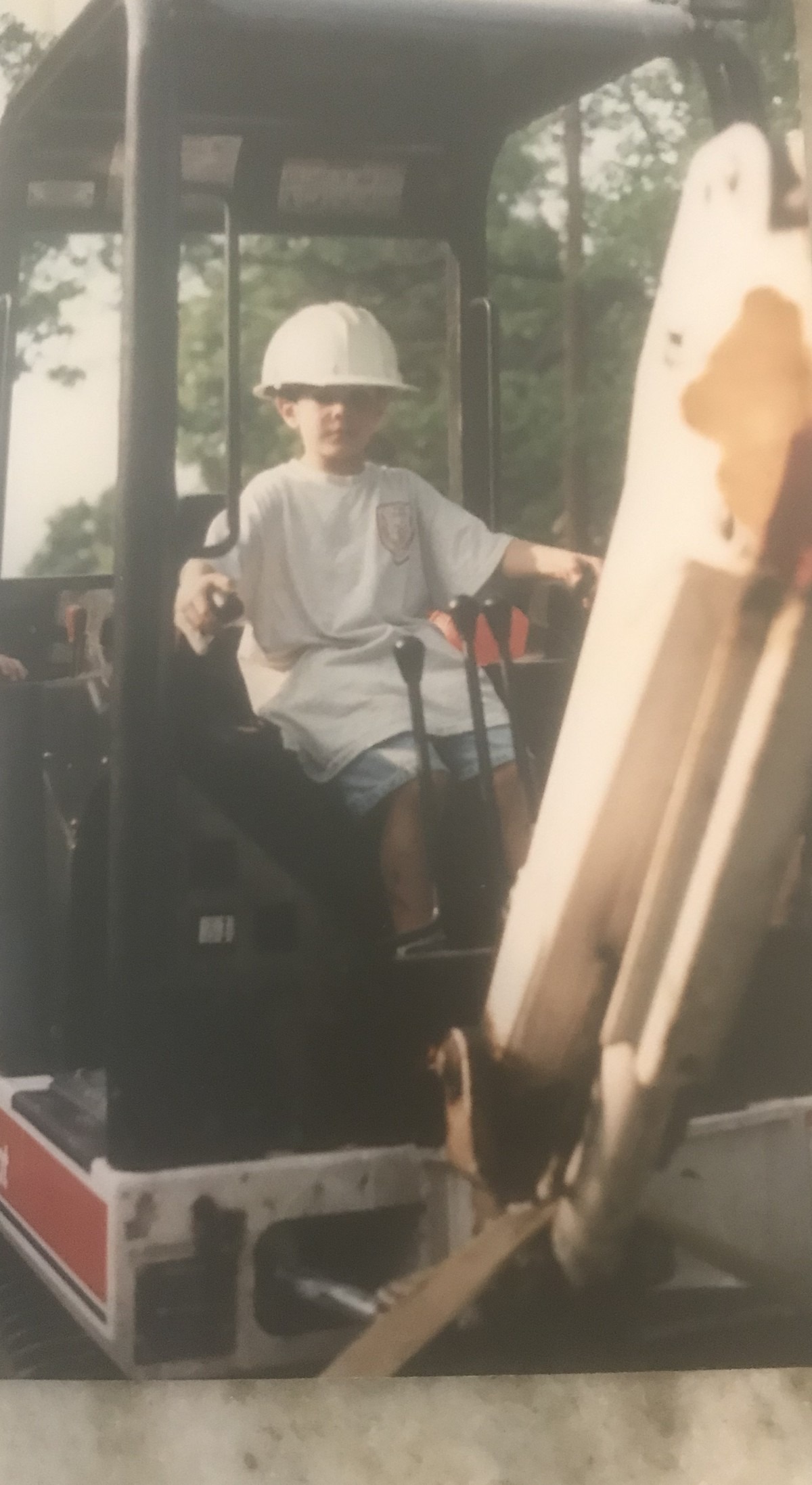
Justin as a kid sitting in the machine on the trailer

I look at that picture of me sitting in the machine, my hands on the controls, my hard hat on, a straight face, looking right at the camera.

And I think to myself:

"This is where it started."

I was in the seat before I was old enough to know better.

That's me as a kid, sitting in my uncle's machine, on the trailer, behind the truck, out in the street.

All the kids were in the backyard playing at the birthday party.

But my brother, my sisters, my cousins and I were outside playing with the excavator on the trailer.

Because that was normal for me.

That was normal for my family.

Nobody rented that machine for a kid's birthday party.

That machine was on that trailer because all the men in my life were working.

They happened to be working two towns up the road on a Saturday, and my house happened to be on the way back to the shop.

So they brought the machine home.

They brought it to the birthday party.

And to me, there was nothing unusual about it.

That was just how I grew up.

While other kids were playing with toys, we were playing on construction equipment.

I didn't know it then, but looking back at that picture now, I can see it clearly.

I was already in the seat.

Chapter Four

Claw Hammers

One memory in particular has always stayed with me.

It was me, my brother, and my cousin.

My dad was driving the first tri-axle dump truck our family ever had.

My uncles were working on the job, and my youngest uncle was watching the three of us.

He was our babysitter.

We were on a public works project, working at a school in Bergen County.

I remember the three of us hanging around my uncle's Ford F-250 while my youngest uncle found a way to put us to work.

He gave us claw hammers, and we started digging a hole.

And we actually thought we were helping.

We were kids, but as far as we were concerned, we were part of the crew.

I can still remember it.

Looking back now, it makes me laugh.

But it also tells you everything about how I grew up.

Construction wasn't something I went to see.

I was raised around it.

The trucks weren't something I watched from the side of the road.

My dad was driving one.

The machines weren't something I saw on television.

My uncles were operating them.

The jobsite wasn't somewhere I visited.

It was where my family worked—and where I grew up.

Chapter Five

Betsy

There was this old Caterpillar D8 dozer that my family had.

It was ugly. Antique-looking. Big, yellow, rusty iron.

As a kid, you looked at that thing and it was scary.

But we called her Betsy.

And as kids, we loved that machine.

We were always climbing all over it.

I remember the Ringwood development.

My uncle was the developer. He had bought the raw land, and he was building the entire site.

Before there were roads and houses, there were woods.

Trees everywhere.

The first step was clearing the way.

My mom brought us out to the jobsite after they had started clearing the land.

I remember being right there on the tracking pad where the job started.

And I remember sitting on my uncle's lap as we climbed into Betsy.

Then we made the first pass through the woods.

We pushed our way through the trees, clearing what would eventually become the main road through the development.

At the time, I was just a kid sitting on my uncle's lap, riding in an old dozer.

I didn't understand what I was looking at.

I didn't understand that we were standing at the beginning of an entire development.

I just knew that I was in the machine.

I was with my uncle.

And we were clearing the way.

Chapter Six

The Machine Men Became the Craftsmen

As my uncles got older, the machine men began to develop their own specialties.

They had learned the machines.

They had learned the ground.

They had learned how to build.

Then they took that knowledge and pushed it further into the construction industry.

One part of that evolution was athletic fields.

One of my younger uncles became a master of building them.

He took everything he had learned as a machine operator and fine-tuned it into a craft where precision mattered.

Same principle.

Same foundation.

Different niche.

Building an athletic field isn't just moving dirt.

The grade has to be right.

The pitch has to be right.

The drainage has to work.

Every elevation, every slope, every transition has to be on the money.

There isn't much room for being close.

It has to be right.

He was the first one to give me a job.

I worked for him building athletic fields, and that's where I started taking what I'd been watching my whole life and putting it to work.

I learned that operating the machine was only part of the job.

You had to understand what you were building.

You had to understand why the dirt was going where it was going, how the grades worked, how the water moved, and what the finished product needed to be.

That was the standard I was learning.

I watched my uncle develop raw land into homes when I was a little boy.

By the time I went to work for him, his business had evolved into the landfills and Brownfields redevelopment services.

That's where I got another opportunity to learn.

This time, I wasn't just watching the machines.

I was running them.

I was still just a kid, but I knew what to do.

My uncle trusted me with the machine because he knew I'd been around it my whole life.

I'd watched my uncles operate.

I'd sat in the seats.

I'd watched how they moved dirt and handled the work.

So when I finally got the opportunity to operate one myself, I wasn't starting from zero.

I'd been learning the whole time.

My youngest uncle gave me an opportunity to work with him and his team.

He was doing full sitework. All of it. "Whatever it takes."

Demolition.

Excavating.

Concrete.

Underground utilities.

On-site crushing.

Environmental and recycling.

He gave me the opportunity to learn all of it from him and from the company he had built.

I got to see how all of those pieces came together.

I wasn't just learning how to run a machine.

I was learning how the work connected.

From digging and moving the earth, to preparing the site, installing underground utilities, tying rebar, pouring concrete, and taking structures down when they had to come out.

That was another step in my evolution.

I went from watching the work to becoming part of it.

And the same thing was happening throughout my family.

The machine men were taking what they had learned and turning it into businesses of their own.

Every phase of the site.

The machines were there.

The knowledge was there.

And the ability to do the work was there.

They didn't just own equipment.

They mastered it.

They built their businesses around it.

And I was learning from all of it.

From my uncles.

From their crews.

From the operators, laborers, foremen, superintendents, and people in the offices.

I was seeing the field side and the business side at the same time.

That's how I grew up.

And that's how I continued to evolve.
Chapter Seven

The Family Business Was Always Bigger Than One Trade

Looking back at my family's history, there is one word that ties almost all of it together:

Logistics.

Construction is logistics.

Every construction project requires people, equipment, materials, dirt, stone, concrete, and everything else needed to build it, to be moved, coordinated, delivered, and put in the right place at the right time.

That's the world my family grew up in.

A truck moves the material.

A machine moves the dirt.

A quarry produces the aggregate.

Raw land gets cleared and developed.

Something gets built.

Years later, it gets demolished.

The concrete gets crushed.

The material that can be reused gets recycled.

What's left gets hauled away.

And eventually, it ends up in the landfill.

The landfill gets filled.

It gets capped.

And then what?

We redevelop it.

Chapter Eight

The Next Generation

There was never a moment when I decided to get into construction.

I was already in it.

I grew up in it. As a kid, I played on the same jobsites where my family worked. I sat in machines, rode in trucks, and watched my uncles build their businesses.

As I got older, playing on the jobsite became working on the jobsite.

There was no transition.

I just kept growing.

I worked for each of my uncles and learned from them and from the teams they built around them.

Construction wasn’t just what happened on the jobsite. It was our family business, our everyday life, and what we talked about around the dinner table, with the whole family involved.

I learned the business from the inside out.

Then I spent nearly a decade working out of the union hiring hall as an Operating Engineer, working for some of the largest construction companies in New York and New Jersey, and on major private, public works, and infrastructure projects.

I took all of that experience and built JR Ramco.

JR Ramco was built on purpose, with a purpose.

I was taught to do the right work.

Take care of your people.

Take care of your customers.

And always do the right thing.

Those are the values I was raised with, and they are the values I built JR Ramco around.

To be the solution when the work is critical and it has to happen now.

Everything we do is mission-critical or on the critical path.

I’ve spent my entire life watching my family build businesses, take risks, see opportunities, and turn ideas into something real.

I grew up around entrepreneurs and visionaries.

Now I’m carrying that forward.

From the jobsites of my childhood, the Blizzard of 1996, when the snow was over my head, to the work we do today.

Because this isn’t the end of the story.

It’s the next generation.

I’m not new to this. I’m true to this.

Justin R. Ramirez

Second-Generation Public Works Contractor

Second-Generation Operating Engineer

Third-Generation Entrepreneur

Founder of JR Ramco

We’d love to hear your story

Share your story